01
Practical teaching model
Make sensors, machine data, connectivity and dashboards visible and understandable for students and trainees.
The RealTimeBox Barista was developed as a test and teaching model for Koninklijke Metaalunie. We show how an existing, non-smart coffee machine can be digitised with reliable sensors, real-time data and an open data layer. The same principle can be applied as a retrofit to real production machines.
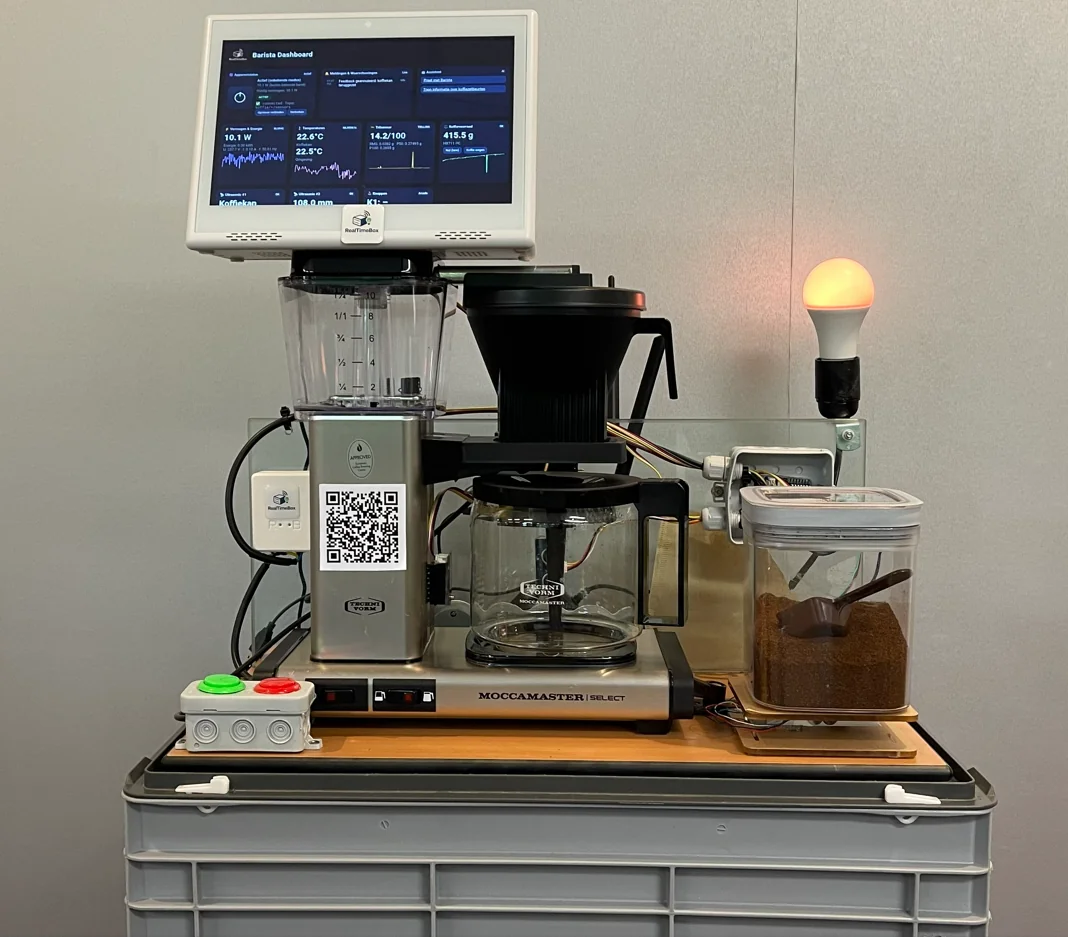
We built this Barista as a test model and teaching material for Koninklijke Metaalunie: a recognisable example of how an ordinary, non-smart coffee machine becomes a connected device. The machine is the demonstration; the underlying sensor technology and data architecture are also applicable in real production environments.
Make sensors, machine data, connectivity and dashboards visible and understandable for students and trainees.
Give existing production machines a digital upgrade without replacing the complete machine.
RealTimeBox can develop compact demonstration set-ups for vocational, higher and practical education.
Start with a few stable measurement points and expand the set-up later with a database, analyses and smart functions.
The RealTimeBox Barista was developed as a test and teaching model to show how an ordinary coffee machine can become a smart device with sensors, data and connectivity. This approach is also interesting for technical education and industrial retrofits.
 Space for logo
Reference: RealTimeBox Barista — educational test and demonstration model.
Add the official logo asimages/metaalunie-logo.png to show it here.Even for existing production machines, working smarter starts with reliable measurement signals. RealTimeBox provides a scalable data foundation without replacing the complete installation.
The hardware can be configured to suit each customer. Sensors and devices remain vendor-independent and can easily be replaced or expanded later.
Keep the existing machine and add only the required sensors and connectivity.
Temperature, cycles, usage and deviations immediately visible.
Build enough process history to investigate deviations and develop predictive analyses.
The same approach is usable for many existing industrial assets.
A good AI application does not start with AI, but with reliable measurements. We collect the data in a structured way, build process history and can then add analyses and self-learning models.
Determine which process and quality parameters are relevant. Connect robust sensors and existing machine signals, and verify measurement quality.
Collect signals reliably and in real time in one open, vendor-independent data layer, also alongside existing machine controls.
Record measurements and events in a database. Comparing trends, conditions and product quality creates valuable process history.
Use enough representative data to recognise deviations, investigate causes and eventually enable self-learning analyses or maintenance advice.
Imagine product quality slowly declining. Instead of only looking at an alarm or graph, you ask the machine: “Why is the quality of my product getting worse, and where can we solve that?”
A smart assistant could then compare measured values, production results and historical patterns, point out possible causes and suggest targeted investigation or adjustments. Think of temperature deviations, changing cycle times, wear or a sensor value that is slowly drifting.
This is the development direction, not an existing standard function of the Barista test model. First build a stable sensor base and reliable data, then data quality and analysis, and only after that self-learning models and natural interaction with the machine. Recommendations and any adjustments remain testable and under the user’s control.
Netvion and Seeed Studio are partners of RealTimeBox.


Whether it is a scale model for vocational, higher or practical education, or a retrofit on an existing production line: we start with reliable signals, build the database and data layer, and develop the required analyses and intelligence from there.